Why reading time matters
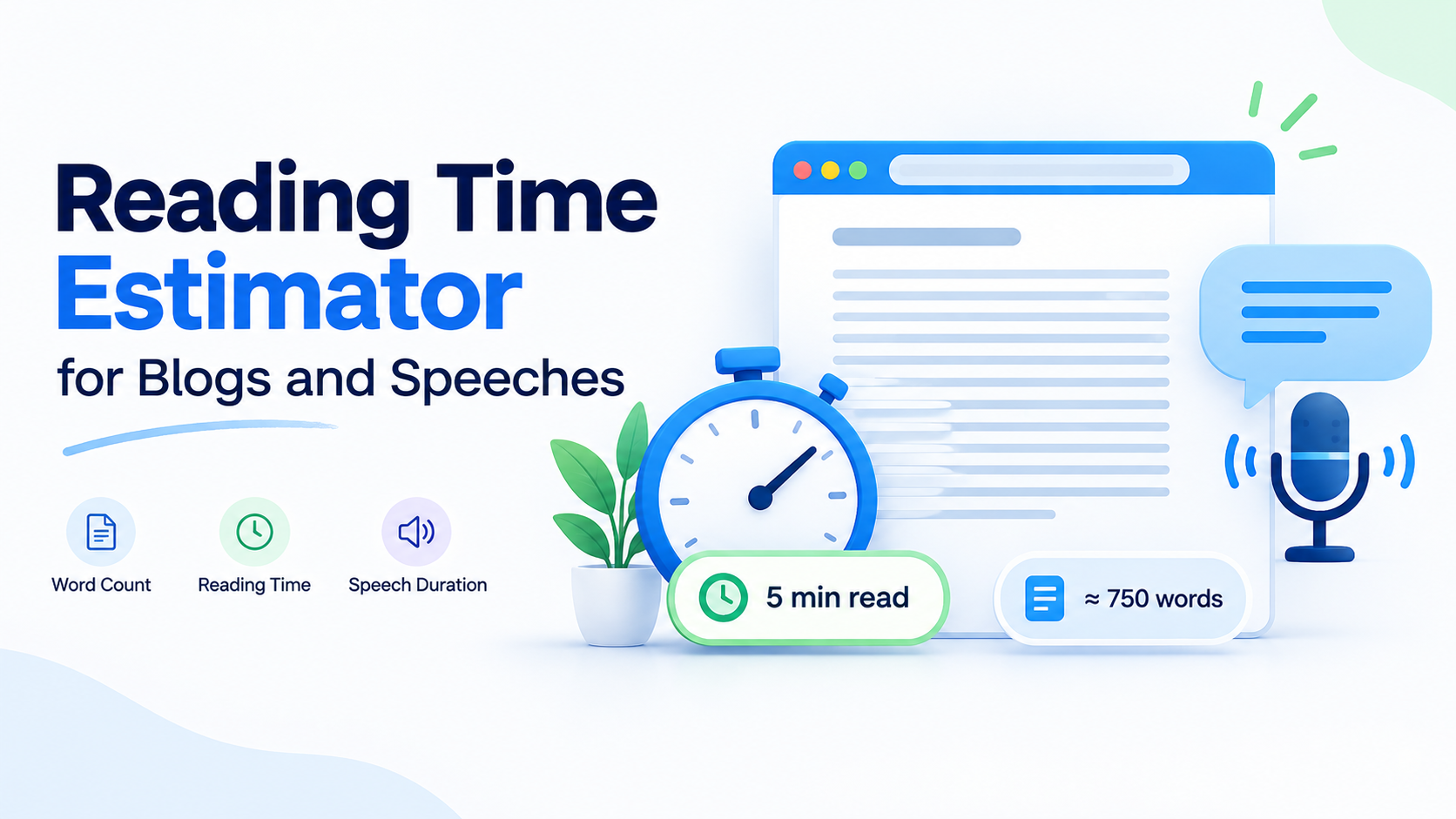
When a reader lands on your blog post, they make a split-second decision: do I have time for this? If they can't tell, many will bounce. A simple "5 min read" label answers that question before they ask it.
For speech writers, the stakes are even higher. You have a fixed time slot — 5 minutes, 10 minutes, 20 minutes — and no way to speed up or slow down mid-delivery without losing the room. Knowing your word count tells you whether your draft fits the slot before you step on stage.
Reading time estimation isn't just a nicety. It's a planning tool that affects:
- Bounce rate. Posts with a clear reading time label see better engagement because readers self-select.
- Dwell time. Readers who commit to a 7-minute read are more likely to actually read it.
- Content strategy. Knowing that your average post is 12 minutes tells you something about your audience's patience.
- Speech preparation. No more last-minute cuts because your 10-minute slot is suddenly 18 minutes of material.
Use the Reading Time Estimator for blog posts and the Speaking Time Calculator for speeches and presentations. Both run instantly in your browser.
Reading time for blog posts
The standard formula is simple: word count ÷ reading speed = reading time in minutes. The tricky part is picking the right reading speed.
What WPM should you use?
Most blogs use 200–250 words per minute. Here's how that breaks down:
- 200 WPM: Technical content, academic writing, or anything that requires careful reading.
- 225 WPM: The sweet spot for general blog content. Medium uses 265 WPM, but that assumes a faster average reader.
- 250 WPM: Light content, listicles, and posts meant to be skimmed.
If you're not sure, start with 225 WPM and adjust based on your audience. A developer blog should use 200 WPM. A pop-culture blog can get away with 250 WPM.
What's a good reading time?
There's no universal answer, but the data is consistent:
| Reading Time | Reader Perception | Best For |
|---|---|---|
| Under 3 minutes | Quick hit, might feel thin | News updates, quick tips |
| 3–6 minutes | Comfortable, easy to commit | Most blog posts, tutorials |
| 6–10 minutes | Substantial, worth the time | In-depth guides, case studies |
| 10–15 minutes | Long read, needs a strong hook | Pillar content, research |
| Over 15 minutes | Commitment, many will save for later | Definitive guides, books |
Should you include images and videos?
Yes — they add time. A common rule of thumb is to add 15–30 seconds per visual element. A post with five images and one video might add 2–3 minutes to the estimate. The Reading Time Estimator lets you account for this.
Where to show the reading time
The label should be visible before the reader starts scrolling. Best placement:
- Byline area (next to the date and author) — most common
- After the first paragraph — for posts with long intros
- In the featured image overlay — for visual-heavy blogs
Format it as "5 min read" or "5-minute read." Shorter is better. Don't say "5 minutes and 23 seconds" — round up to the nearest minute and add "min read."
Speaking time for speeches
Speaking time is different from reading time. We read faster than we speak, and the gap matters more than most people realize.
How fast do people speak?
A comfortable presentation pace is 130–150 words per minute. That's slower than reading speed because:
- You pause for effect.
- You wait for audience reactions.
- You breathe.
- You slow down for complex points.
Here's how speaking speed varies by context:
| Context | Words Per Minute | Best For |
|---|---|---|
| Formal / complex | 110–125 WPM | Academic presentations, second-language audiences |
| Presentation pace | 125–145 WPM | Most speeches, conference talks, video scripts |
| Conversational | 145–160 WPM | Podcasts, informal talks, energetic delivery |
How many words for a 10-minute speech?
At 140 WPM (a solid middle ground), 1,400 words is about 10 minutes. But budget for:
- Pauses: Add 10–15% for natural pauses.
- Audience reactions: Add time for laughter, questions, or applause.
- Transitions: Moving between slides or demos eats time.
A safer rule: 1,200–1,300 words for a 10-minute slot. That gives you room to breathe without rushing.
Read your script aloud once and time it. Your actual delivery pace is almost always slower than the calculated estimate. The Speaking Time Calculator gives you a baseline — your rehearsal gives you the truth.
How to estimate it
1 Paste your text
Open the Reading Time Estimator and paste your blog post or speech into the input box. The tool counts words instantly.
2 Choose your reading speed
For blog posts, pick 200–250 WPM depending on your content type. For speeches, switch to speaking mode and choose 125–145 WPM for a presentation pace.
3 Account for visuals
If your post has images, charts, or videos, add 15–30 seconds per visual element. The estimator can include these if you provide the count.
4 Round up and display
Round up to the nearest minute. Display the label near the top of your post, next to the date and author name.
Reading Time EstimatorPaste your text, get reading time and speaking time instantly
Words per minute reference table
Use this table to quickly estimate reading or speaking time for common word counts.
| Word Count | Reading (225 WPM) | Speaking (140 WPM) | Speaking (120 WPM) |
|---|---|---|---|
| 250 words | ~1 min | ~2 min | ~2 min |
| 500 words | ~2 min | ~3.5 min | ~4 min |
| 750 words | ~3 min | ~5 min | ~6 min |
| 1,000 words | ~4.5 min | ~7 min | ~8 min |
| 1,500 words | ~7 min | ~10.5 min | ~12.5 min |
| 2,000 words | ~9 min | ~14 min | ~17 min |
| 3,000 words | ~13 min | ~21 min | ~25 min |
These are estimates. Your actual numbers depend on content complexity, audience familiarity, and delivery style.
The reading time checklist
- Count words. Use the Word Counter to get an accurate count.
- Pick your speed. 225 WPM for general blogs, 140 WPM for speeches.
- Add visual time. 15–30 seconds per image, chart, or video.
- Round up. Always round to the next full minute.
- Display it. Put the label near the top, next to the date.
- Rehearse if speaking. Your actual pace is your best estimate.