Why capitalization rules matter
Capitalization isn't just decoration. It's a signal. It tells readers what's important, what's a heading and what's body text, what's a proper noun and what's not. Get it wrong and your writing looks careless — even if the content is excellent.
The problem is that different contexts call for different rules. A blog headline follows different conventions from a body paragraph. A formal report uses different capitalization from a social media post. And acronyms — like JSON, PDF, or SEO — follow their own logic entirely.
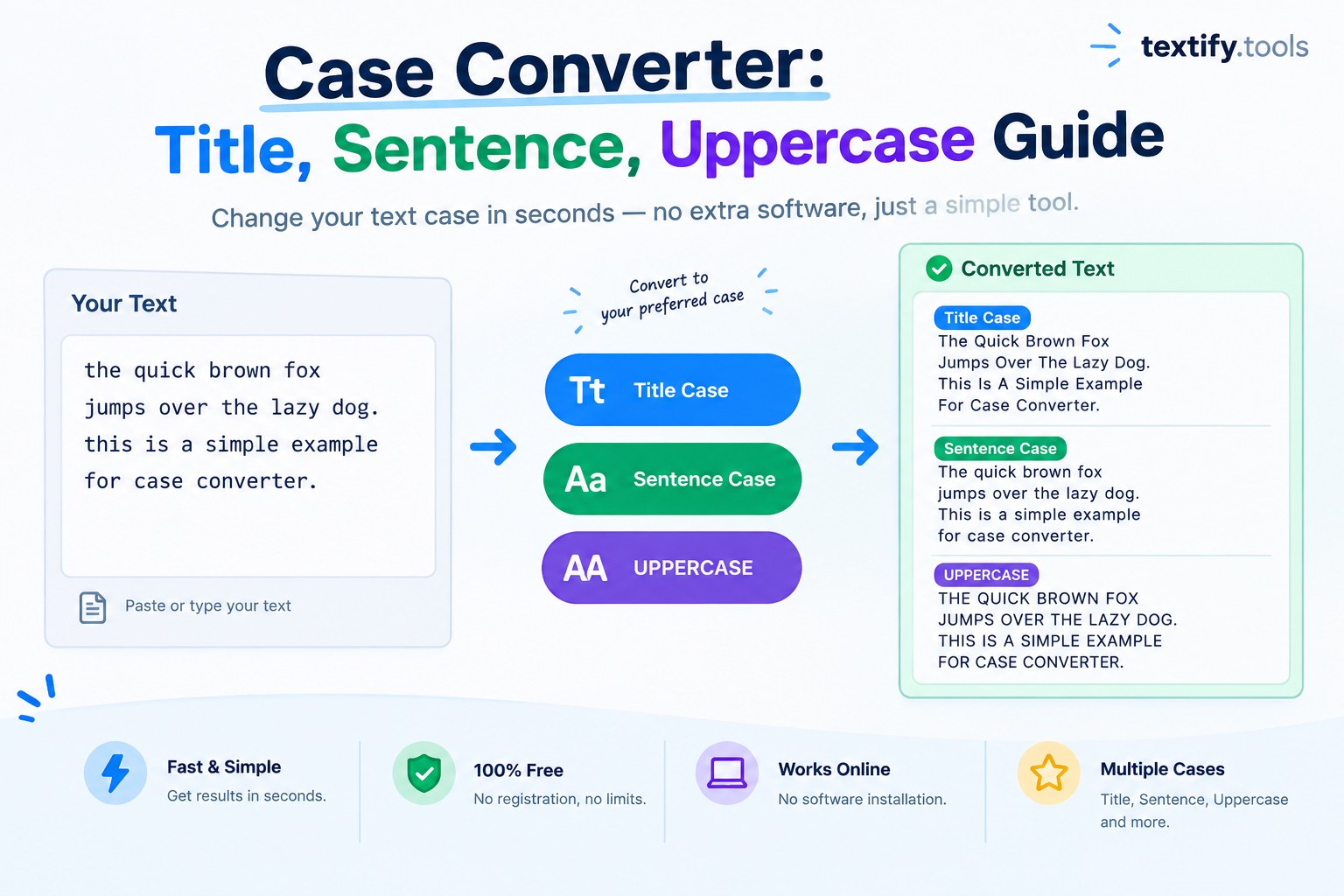
This guide covers the three capitalization styles you'll use most often — Title Case, Sentence case, and UPPERCASE — and gives you a clear rule for when to use each.
Use Title Case for formal headlines and titles. Use Sentence case for body text and conversational headings. Use UPPERCASE only for short labels, acronyms, and rare emphasis.
Title Case: rules and when to use it
Title case capitalizes the first letter of every major word in a title or heading. What counts as "major" is where it gets tricky — but the core rules are consistent across most style guides.
The core rules of title case
- Capitalize the first and last words of the title, no matter what they are.
- Capitalize all nouns, pronouns, verbs, adjectives, and adverbs.
- Keep lowercase articles:
a,an,the. - Keep lowercase coordinating conjunctions:
and,but,or,nor,for,so,yet. - Keep lowercase short prepositions (under five letters):
at,by,for,in,of,on,to,with.
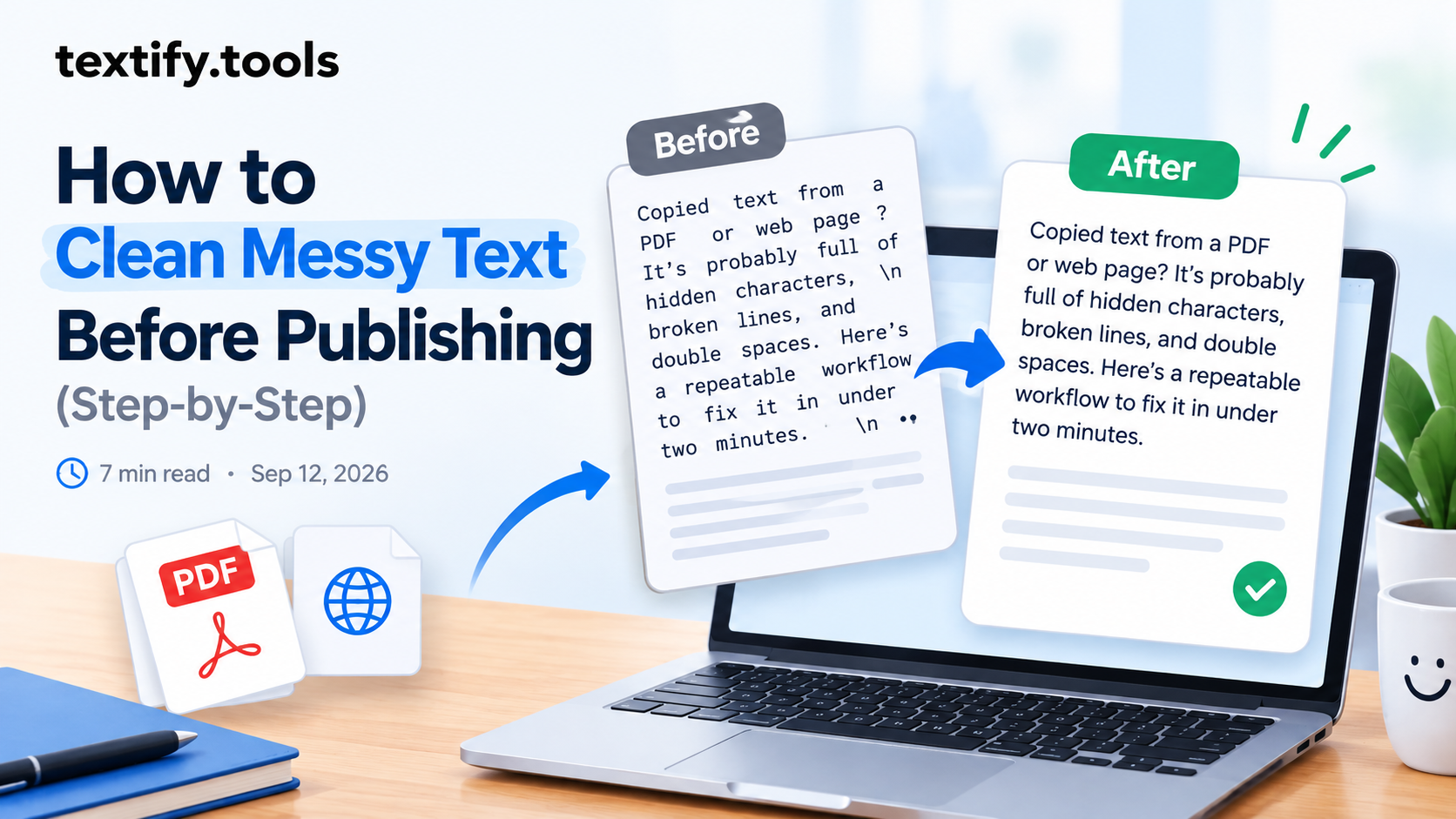
How to Clean Messy Text Before PublishingHow To Clean Messy Text Before PublishingThe second example is wrong because "to" is a short preposition and should stay lowercase. This is one of the most common title case mistakes — capitalizing short prepositions because they "feel" important.
When to use title case
- Formal article and book titles. "The Quick Brown Fox Jumps Over the Lazy Dog."
- News headlines. Most newspapers and news sites use title case for headlines.
- Academic paper titles. APA and Chicago style both use title case for article titles.
- Presentation slide titles. Title case gives each slide a sense of structure.
- Navigation labels and button text. "Sign Up," "Learn More," "Get Started."
Convert any text to proper title case instantly
Sentence Case: rules and when to use it
Sentence case capitalizes only the first word of a sentence — and any proper nouns. Everything else stays lowercase. It's the default for body text and increasingly the default for web headings.
The core rules of sentence case
- Capitalize the first word of the sentence.
- Capitalize proper nouns: names, places, brands, days, months.
- Capitalize the first word after a colon if it starts a complete sentence.
- Keep lowercase everything else — including most words in a heading.
How to clean messy text before publishingHow to clean messy text in Google DocsIn the second example, "Google Docs" stays capitalized because it's a proper noun. Everything else — including "to," "clean," "messy," "text," "in," "before," "publishing" — stays lowercase.
When to use sentence case
- Body text. Every sentence in a paragraph follows sentence case.
- Blog headings and subheadings. Modern web writing increasingly prefers sentence case for headings.
- Email subject lines. Sentence case feels more conversational than title case.
- Product descriptions. "This tool removes duplicate lines from a list."
- UI copy and labels. "Search tools," "Sign in," "Learn more."
Capitalize the first letter of each sentence
UPPERCASE: when it helps and when it hurts
UPPERCASE is the loudest capitalization style. It demands attention — which is exactly why it should be used sparingly. A little goes a long way. A lot becomes shouting.
When UPPERCASE works well
- Acronyms.
JSON,PDF,SEO,API,HTML,CSS. - Short labels. "NEW," "SALE," "BREAKING."
- Warning messages. "WARNING: This action cannot be undone."
- Legal disclaimers. "TERMS AND CONDITIONS APPLY."
- Form field labels. "NAME," "EMAIL," "ADDRESS" — though sentence case is increasingly preferred here too.
When UPPERCASE hurts readability
UPPERCASE text is measurably harder to read than sentence case. The reason: when all letters are the same height, the brain loses the shape cues that help it recognize words. A word in lowercase has a distinctive silhouette; a word in UPPERCASE is a uniform block.
THIS IS A SENTENCE THAT IS HARDER TO READ BECAUSE EVERY LETTER IS THE SAME HEIGHT.This is a sentence that is easier to read because the letters have different heights.For short phrases, UPPERCASE is fine. For paragraphs or anything longer than a few words, use sentence case instead.
Uppercase ConverterConvert any text to UPPERCASE instantly
Quick comparison table
Here's a side-by-side look at how each capitalization style handles the same text:
| Style | Example | Best for |
|---|---|---|
| Title Case | How to Clean Messy Text Before Publishing | Formal headlines, book titles, news articles, navigation |
| Sentence case | How to clean messy text before publishing | Body text, blog headings, email subjects, UI copy |
| UPPERCASE | HOW TO CLEAN MESSY TEXT BEFORE PUBLISHING | Acronyms, short labels, warnings, legal text |
| lowercase | how to clean messy text before publishing | Stylistic effect, code variables, URLs, hashtags |
Title case across style guides (AP, Chicago, APA)
One reason title case feels confusing is that different style guides have slightly different rules. The differences are subtle, but they matter for formal publishing.
| Style guide | Rule for prepositions | Rule for conjunctions |
|---|---|---|
| AP Style | Capitalize prepositions of 4+ letters (With, Between, Through). Lowercase shorter ones (in, on, at, of). | Lowercase all coordinating conjunctions (and, but, or, nor, for, so, yet). |
| Chicago Style | Lowercase all prepositions regardless of length, unless they start or end the title. | Lowercase all coordinating conjunctions. |
| APA Style | Capitalize prepositions of 4+ letters. Lowercase shorter ones. | Lowercase all coordinating conjunctions. |
| MLA Style | Capitalize all principal words, including prepositions. Lowercase only articles and conjunctions. | Lowercase coordinating conjunctions. |
The takeaway: if you're writing for a publication with a specific style guide, follow that guide. If you're writing for yourself or a general audience, pick one style and apply it consistently. Consistency matters more than which style you choose.
Case ConverterConvert to uppercase, lowercase, title case and more
The capitalization checklist
- Identify the context. Is it a heading, body text, or a label?
- Choose the right style. Title Case for formal headings; sentence case for body and web headings; UPPERCASE for acronyms and short labels.
- Check your prepositions. In title case, keep short prepositions lowercase.
- Check your acronyms.
JSON,PDF,SEOstay uppercase.ApiandJsonlook wrong. - Be consistent. Pick one style for headings across your whole site and stick to it.
- Use a tool. The Case Converter handles all these styles in one click.